Zipline, a leading drone operator, will begin delivering prescription medicines to patients’ homes in a suburb of Charlotte, North Carolina, this year, helping usher in the long-anticipated era of routine drone drops.
Why it matters: Battery-operated drones could satisfy our demand for “instant delivery” in less than 15 minutes, while easing traffic congestion, improving safety and helping the environment…
The trial, which awaits the FAA’s nod, will take place in and around Kannapolis, North Carolina, where Zipline has a distribution center serving nearby hospitals…
A big milestone will occur in a few months when Wing begins drone deliveries in Dallas, its first major metropolitan service area, starting with Walgreens.
Even as this article makes clear that this is already happening in other places, the suburban potential is intriguing for several reasons:
If drones can deliver a lot of goods in suburbia, could this help unlockthe hold of driving on suburbia or does it enable people to live even further apart?
How do drones fit in a suburban landscape devoted to private property and proximity to nature? Drones could theoretically be quieter and less obvious than other options yet this could be considered intrusive in a new use of local airspace. Could some local governments ban their use?
I wonder this about delivery possibilities now: how close do distribution centers or drone centers need to be to residential neighborhoods to enable same-day or quicker delivery? Residents like the idea of quicker delivery but having warehouses and distribution centers closer to homes has some limits.
It sounds like these drone deliveries are going to happen and they have the potential to impact suburban life in small – and maybe larger? – ways.
Actor Brad Pitt created a foundation that built 109 affordable housing units in New Orleans after Hurricane Katrina. According to one observer, the project has not gone well:
Brad Pitt’sMake It Right Foundation built 109 eye-catching and affordable homes in New Orleans for a community where many people were displaced by damage wrought by Hurricane Katrina in 2005. Now this housing development is in disarray. The vast majority of the recently constructed homes are riddled with construction-related problems that have led to mold, termites, rotting wood, flooding and other woes.
Pitt’s lawyers argued that he could not be sued over the housing development’s failings, but a judge ruled in 2019 that the movie star would remain a defendant because of his role as Make It Right’s founder and chief fundraiser.
What happens in the end because of the efforts of the celebrity? Here, the outcome does not sound good: the homes are in disrepair and court cases are pending. The homes that were intended to help are their own problem.
To repeat, tackling affordable housing, even with the help of a megastar, is no easy task.
Herbert recommended a different way of thinking about the timing of buying a house, one that I found much more comforting. “You ought to be making this as a housing decision and not an investment decision,” he said. If you’re buying a house, he advised, it should be because you want to live in it for at least five years, and ideally many more – which also will mean that even if prices fluctuate, you have a better chance of your investment appreciating over time. “The longer you stay in the house, the [less] your timing in this particular house-price cycle [will] matter,” he said.
This quote interested me for two reasons. First, Herbert says this is about buying a house and staying long term. Sure, the housing market might be crazy right now but a buyer should be thinking about living in the space for a while. But, then the advice pivots a bit to noting how this long-term view can pay off financially. The particular financial circumstances at purchase will fade away if the price of the home increases.
Perhaps it would take an extended period of a cooler housing market and other positive economic stability for houses to not just be financial investments. Or, the costs of homeownership in many places are already at a point where homes can only be viewed as financial objects.
Originally introduced in Berkeley, Calif., in 1916 as a means of preventing a black-owned dance hall from opening, single-family zoning became increasingly popular — though divorced from its explicitly racist origins — as more Amercans moved to sprawling suburban cities across the country. Today, many of the country’s major urban areas reserve 75 percent or more of their residential land exclusively for stand-alone, one-family homes.
Recently, lawmakers in blue states and cities have moved to roll back zoning rules in hopes of spurring more development. Minneapolis became the first major city to ban single-family zoning in 2019. That same year, Oregon passed a similar law statewide. Perhaps the most significant change came in California where the median home price is estimated to exceed $800,000. A new law that eliminates single-family zoning across the entire state went into effect on Jan. 1. None of these reforms make it illegal or even more difficult to build a stand-alone house, they simply remove barriers that prevent any other type of dwelling from being built.
Advocates for eliminating single-family zoning say it’s the most important step toward addressing the housing shortage, since any other programs to spur more development would be moot if there’s no land to legally build on. Supporters say eliminating what they often refer to exclusionary zoning would have wide-ranging benefits beyond just creating more housing stock, including reducing racial segregation and closing the racial wealth gap, boosting job opportunities in urban areas and reducing climate impacts created by suburban sprawl.
Many conservative opponents of these reforms, including former President Donald Trump, have portrayed them as a “war on the suburbs” that would bring big-city problems to quiet communities while doing little to address the underlying causes of the housing shortage. Some argue that financial incentives, not coercive new laws, are the best way to spur development.
A lot of pro-housing advocates also have doubts about how much of an impact zoning reforms on their own will make. They argue that most of the new laws are riddled with exceptions that limit their scope and few also address the long list of other ways that local governments can prevent dense housing from being built — like minimum lot sizes and parking requirements. Some on the left make the case that the only way to increase housing supply at the pace that’s necessary is through strict mandates that require cities to build a certain number of housing units and impose heavy financial penalties on those that don’t.
As about any policy possibilities in the United States, I now wonder if what would work best in this situation is for several different kinds of communities across the country to ban single-family zoning and see what happens. What changes in the community? How do residents and newcomers experience it? How does it affect housing values? Does it significantly alter the character of the community? And if there are success stories – which could range from limited noticeable change (that it does not lead to negative outcomes or the end of the suburbs might be good enough) to positive outcomes – then other communities could observe and consider the option.
The Chicago Bears hired a new head coach this week. Prior to the hire, the conversation about what qualities the new coach should have reminded me of sociologist Max Weber’s definition of charismatic authority. Here is how one scholar summarizes the concept:
According to Max Weber’s concept of “charismatic authority,” charisma is based on a social relationship between the charisma holder and the charisma believer. The Weberian perspective is not focused on analyzing the personality of the charismatic leader, but rather on the structure of the charismatic social relationship. The social structure that comes out of a charismatic relationship represents an emotional collectivization held together by an emotional bond with the leader. A charismatic leader is not only a person who is given great expectations and trust and to whom special skills are attributed. A charismatic leader constitutes a new leadership, a new structure of social relationships, and a new cognitive definition of the situation of social action.
Contrast this with some of what I heard a successful coach should be able to do:
-connect with players
-hold players accountable for performance
-have a track record of success
-help players develop and grow
-command any situation
-show confidence
-have a plan and execute it
-build and sustain a (successful) culture
-WIN!
Many of these traits can be expressed in different ways. Measuring some of them is difficult. Can a number of them only be ascertained by having a close relationship with the coach and/or being in the same room and experiencing the charisma and magnetism of that coach?
To some degree, these traits apply to numerous leadership roles. The football coach as a “leader of men” is glamorized and masculinized but business, civic, and political leaders are supposed to embody at least a few of these these traits as well. Those who do well might have the charismatic authority, those who do not make it do not.
ON THE FRINGES of greater Paris, where urban concrete meets farmed fields, lies the suburb of Saint-Brice-sous-Forêt. Gently curved streets of two-storey houses, each with a parking space and garage, cover what were once apple and pear orchards. The narrow high street has just one café, and a “Cheesy Pizza” takeaway joint; but there is a drive-in Burger King on the outskirts. This is what the mayor, Nicolas Leleux, calls “the border of two universes”: city and countryside. It captures the worries and hopes of middle France, and exemplifies a crucial electoral battleground for April’s presidential poll.
Shy of extremes, the suburb tilts to the centre-right. In 2017 Saint-Brice-sous-Forêt preferred the centre-right presidential candidate, François Fillon, in the first round, but backed the centrist Emmanuel Macron against the nationalist Marine Le Pen in the second. In 2020 it replaced a centre-right mayor with Mr Leleux, a former navy submariner who belongs to Mr Macron’s party. Locals, in other words, may be torn at the presidential poll this time between a vote for Mr Macron, assuming he runs for re-election, and his centre-right rival, Valérie Pécresse. A well-known figure locally, she is the president of the Ile-de-France region, which encompasses the city of Paris itself and Saint-Brice-sous-Forêt, 17 kilometres (11 miles) away…
What comes into sharpest relief in Saint-Brice is the collision between the needs of daily life, notably the car, and the desire for a greener future. A place of quiet middle-of-the-road aspiration, it evokes what Mr Leleux calls the “French dream”. “People have left the city to come here, not to live in a tower block, but in a house with a little garden, with neighbours, and a place to barbecue.” Nearly 88% of households own at least one car. His task, he explains, is to reconcile that dream with the need to reduce car usage. Few can afford an electric vehicle. Mr Leleux is planning cycle lanes and building a bike shelter at the railway station, on a direct line to Paris. Yet on a cold day in January there are no cycles to be seen on the streets…
Fashionable Parisian talk of the ideal “15-minute city” is all very well, says Mr Leleux. The reality is that to buy a baguette in under 15 minutes without a car is not possible in much of suburbia. If anybody has learned this, it ought to be Mr Macron, who won a huge majority of the vote in big cities in 2017, but later faced months of gilets jaunes protests. For now, insists the mayor, locals credit the president nonetheless with having been a “good captain” in difficult times. In April, it is on the streets of middle France, not the parquet-floored salons of Paris or its tenements, that such a claim will be tested.
The focus in this analysis is on cars as a divisive political issue. Can suburbanites afford electric cars? If they cannot, what does this mean for suburban life? I could imagine a similar question in the United States with numerous manufacturers moving to electric vehicles
But, I wonder if the electric car is just a symptom of deeper differences based on how the car factors into the fabric of suburban life. In the United States, I have argued that homes, cars, and a way of life are all connected in suburbia. It is not just that a new kind of car is expensive; any disruption to driving changes suburban life. Cars help enable larger yards, private space, and separated land uses. People want amenities to be within a 15 minute drive and this significantly widens their travel radius compared to walking.
In the meantime, I will keep an eye out for more analysis from France to see if the suburbs matter in elections in the same way as they have mattered in recent American election cycles.
I have always enjoyed the music of composer Antonín Dvořák. I am familiar with most of his compositions, starting as a kid listening to Symphony #9 over and over to finding many favorites later.
What if American music had followed his lead in weaving American songs, particularly Black music, into classical compositions? I am finishing up the recent book Dvorak’s Prophecy: And the Vexed Fate of Black Classical Music. The publisher’s description:
In 1893 the composer Antonin Dvorák prophesied a “great and noble” school of American classical music based on the searing “negro melodies” he had excitedly discovered since arriving in the United States a year before. But while Black music would found popular genres known the world over, it never gained a foothold in the concert hall.
Joseph Horowitz ranges throughout American cultural history, from Frederick Douglass and Huckleberry Finn to Gershwin’s Porgy and Bess and the work of Ralph Ellison, searching for explanations. Challenging the standard narrative for American classical music fashioned by Leonard Bernstein and Aaron Copland, he looks back to literary figures—Emerson, Melville, and Twain—to ponder how American music can connect with a “usable past.” The result is a “new paradigm” that makes room for Black composers including Harry Burleigh, Nathaniel Dett, William Dawson, and Florence Price to redefine the classical canon.
Horowitz argues American classical music ignored and sidelined Black composers and music. Is there an alternative history that could have occurred?
While this falls out of bounds of typical academic research, it can be useful at times to think about ways events and narratives could have gone. In “”Objectivity” in Social Science and Social Policy,” Max Weber said sociology is interested in “on the one hand the relationships and the cultural significance of individual events in their contemporary manifestations and on the other the causes of their being historically so and not otherwise.”
Horowitz hints at least three ways an alternative timeline could have gone: (1) more classical musicians attuned to American songs and culture rather than turning to European forms and/or modernism; (1) more recognition and knowledge about Black composers; (2) the inclusion of jazz in classical music and American culture more broadly; and (3) more classical music attuned to and drawing on American songs and culture rather than turning to European forms and/or modernism.
If these things had happened, what might be different? As a big fan of the Beatles, I think of ways that their music was directly influenced by numerous American Black rock ‘n’ roll artists. And they were not alone; so did Elvis and the Rolling Stones and others. Yet, when they presented their music as white artists, would the reception have been different if Black music had a more prominent role in the classical world starting in the late 1800s?
There is a lot to consider here and I look forward to finishing the book and exploring more of the music Horowitz write about.
Suburbs compete with other communities. They engage in decisions and branding that might given them a particular status and/or an edge. Does this fit a possible decision in Alvin, Texas?
Elected officials in the city of Alvin are considering an all-out ban on abortion that would declare the Houston-area suburb a “sanctuary city for the unborn,” even with the procedure virtually banned by a new state law.
One of the leaders behind this measure said he aimed to make Alvin, a city of about 26,000 residents in northeastern Brazoria County, a “trailblazing” pro-life city.
The ACLU has pushed back on cities that have implemented similar ordinances in the past, arguing they are unconstitutional and that “cities cannot punish pro-abortion organizations for carrying out their important work.” Abby Ledoux, spokesperson for the Planned Parenthood Federation of America, said the ordinance feels “extremely cruel” and just adds more restrictive layers to the statewide ban, ultimately endangering women in an area where access to abortion care is already limited.
On one hand, there is the aspect of leaders and residents believing this is the right stance. Numerous communities have developed statements, regulations, and ordinances intended to pursue what they think is right.
But, I wonder if this is also connected to branding. Could a community serve its residents and seek to attract residents, businesses, and others based on taking a particular stand? At the least, the suburb of Alvin might be known by more people from taking a stand and others might factor the community’s stance into a decision about staying there or moving there.
This reminds me of the work of scholar Thomas Vicino in Suburban Crossroads: The Fight for Local Control of Immigration Policy. This book highlights the efforts of three communities to develop and enact their own policies amid concerns about federal immigration policies. The context here is a bit different – Texas has new laws regarding abortion, federal law is clear – but the idea is the same: local governments take it on themselves to address a controversial issue that they feel is important.
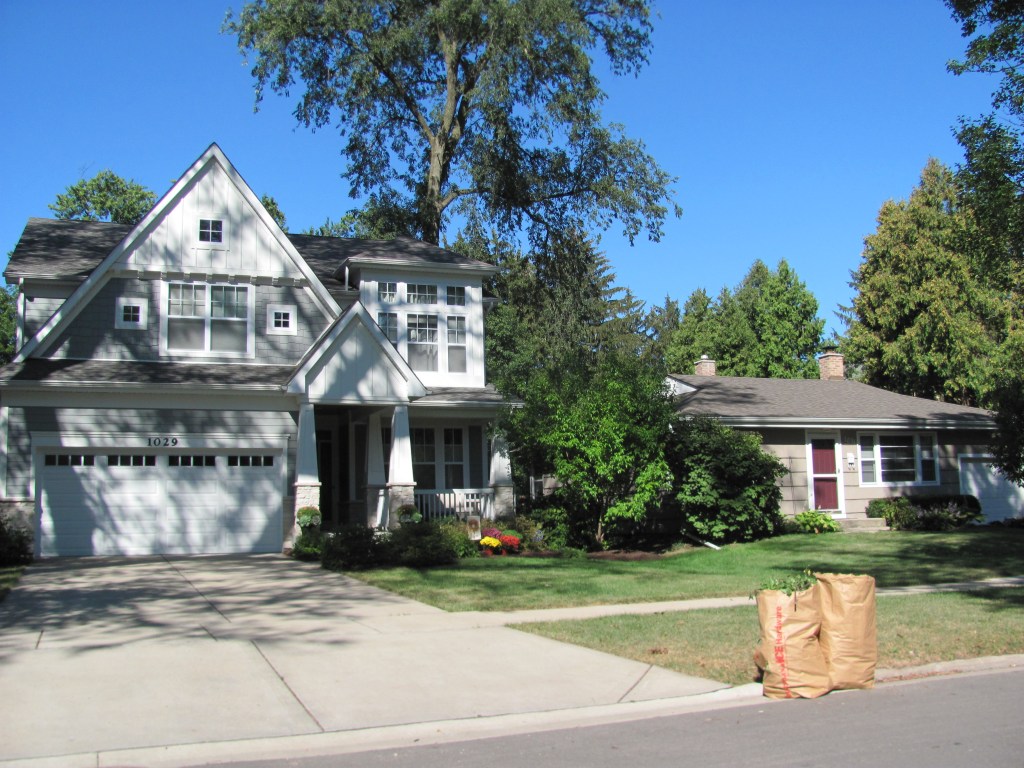
An example of a teardown McMansion – Naperville, Illinois
The modus operandi is always the same: Take a totally usable older house that is the same style and size as neighboring dwellings, though perhaps needing a rehab, and knock it flat, along with every mature tree on the property—there will be no room for them, owing to the enormous footprint of the planned structure. Then construct a particle-board chateau that has at least 75 percent more square footage than the neighbors, complete with a quarter-acre driveway for the obligatory Range Rover…
While the sheer size of the structure guarantees disharmony with the local houses, the eye-lacerating incongruity of its style brings it to a new level. The structures resemble the architecture of the Loire Valley, Elizabethan England, or Renaissance Tuscany—as imagined by Walt Disney, or perhaps Liberace. As with McMansions everywhere, the new owners could have obtained a sounder design for less, but they prefer the turrets, portes-cochères, and ill-proportioned Palladian windows that they bought.
The basic proportions are unfailingly clumsy. The roofs aren’t symmetrical, so that one more giant walk-in closet could be shoehorned in. From the side, this asymmetry and the too-small windows make the construct look like an old sawmill in the Pacific Northwest, or a three-story wooden barracks hurriedly thrown up during World War II. Some manage to look imposing from the front, mimicking George Mason’s brick mansion. But closer inspection reveals the fraud: The front is a brick veneer; the sides and back consist of vinyl siding. Often enough, the brick is a shocking uremic yellow…
The infill McMansion spectacle is a warning and a symptom, like political polarization, of the rising income inequality and concomitant decline of community feeling in the United States. It is not something that fell out of the sky, but a phenomenon that was carefully engineered by financial management.
-Teardowns are a problem in multiple ways. They often do not fit the architecture of neighborhood. They take up too much of the lot on which they are built.
-The size of the teardown and the incongruity with the existing homes are not the only problems: the architecture of the home is subpar. A McMansion can take multiple architectural features and styles and try to mash them together in an imposing array of size and newness.
-McMansions are problematic houses but also symbols of other significant societal problems. The article notes income inequality and a lack of community plus financial intrusion in housing.
So, yes, critics argue teardowns or infill McMansions have some unique disadvantages. But, these concerns about teardowns are connected to concerns about McMansions as a whole.
In recent weeks, the Bolger family, which owns the Gladstone Ridge horse farm on Leask Lane in Wheaton, asked area homebuilders for bids to develop the property. And on Tuesday, the Forest Preserve District’s board voted unanimously to authorize district staff to pursue negotiations with the Bolger family to buy the horse farm.
While no purchase price has yet been determined, some recently developed subdivisions in the immediate vicinity have sold for between $275,000 and close to $500,000 an acre, suggesting that the Bolger family could expect to reap between about $10 million and $17 million for the land from a developer…
“We have not expressed an interest in selling the property to the Forest Preserve (District) and hope you are not of a mind to condemn our property,” she told commissioners. “Please value the rights of our private property and practice open communication.” Forest preserve districts use condemnation to purchase land through eminent domain…
Forest Preserve District officials haven’t yet said publicly if they would consider using condemnation powers to acquire the farm now if they are unable to reach an agreement with the Bolger family. And Wheaton officials said that they have not yet been approached by a developer seeking to develop the Bolgers’ land.
This is different than noting decades ago that the last farms were disappearing from DuPage County. At that point, the farms disappeared to new subdivisions that continued the process of mass suburbanization. Redeveloping a horse farm or an office park or another large property now is different: it does not occur under conditions of mass construction, there are neighbors to the property who likely have concerns, and municipalities and other government agencies think carefully about what the next use for a property could be. The character of the nearby neighborhoods and communities are already established yet a sizable redevelopment could alter future experiences. In other words, when larger parcels of land are infrequent, the stakes for getting this right may be even higher.








 Legally Sociable